Elmira's assessment roll has not been revalued since 1995, and a roll that sits still
stops being fair. City homes are now assessed at roughly 47%
of what they sell for — but not evenly, and the unevenness is the whole story. A mass
reassessment wouldn't raise taxes; it would realign who pays what, and cut the tax rate
by nearly half in the process.
What Reassessment Would and Wouldn't Do
A common misconception: reassessment doesn't raise taxes. It realigns who pays what.
$37.1MTotal levy — unchanged by reassessment
$65.19Combined rate today, per $1,000 of assessed value
city + county + community college + school, from a 2025 tax bill
$35.64Modelled rate after a reassessment at 85% of market
same levy, a base that nearly doubles
52.1%Residential Assessment Ratio — houses only
NYS, 2025. The figure that applies to a home.
56%Equalization rate — all property
Higher, because commercial and utility parcels pull it up. Never use this
one on a house.
Reassessment shifts burden, it doesn't create money.
The city sets its levy in the budget, and the rate is back-calculated to collect
exactly that. Restating every assessment at market value raises the total taxable base,
so the rate falls in proportion and the same money is collected. What changes is the
distribution: properties are taxed at their true relative values, so
owners of under-assessed homes pay more and owners of over-assessed homes pay less. The
equalization rate also improves, correcting the state-level calculations that distribute
school and county tax burden across jurisdictions.
Because Elmira's homes sit at roughly 47% of market value,
restating them at 85% would nearly double the taxable base — so the rate would
fall from $65.19 to about $35.64
per $1,000. A halved rate on a doubled assessment is the same bill. That is the part
everybody gets wrong about reassessment: the scary new number on your assessment notice
is not the number that gets multiplied by the old rate.
Who Wins and Who Pays More
Modelled across all 5,834 taxable single-family homes in the
city, from 1,668 arm's-length sales.
To work out who would pay more or less, you need one thing the assessment roll doesn't
contain: what each home is actually worth. We estimate it from sales — sort the
city's sales by assessed value, then take the average sale
price in each group. That gives the market value a home of any given assessment
typically fetches, which is exactly what the calculation needs.
How we know this is about right. Across all the homes modelled here, the
assessments come to about 47% of estimated market value. New
York State publishes its own figure for exactly this — the Residential Assessment Ratio,
52.1% for Elmira in 2025. Two independent measurements, taken
from different data by different methods, landing next to each other.
What a reassessment would do to each part of the roll
Median household in each band of current assessed value. The levy is held fixed, so this is
redistribution, not a tax rise.
Current assessed value
Homes
Median assessed
Est. median market value
Median bill now
Median bill after
Change / year
Loading…
Bills use the combined rate of $65.19 per $1,000 of assessed
value now and $35.64 after, both derived from the same levy
over the same parcels. The $40–50K band straddles the crossover and its
direction is genuinely too close to call — it holds more homes than any other, so small
changes in the model move thousands of households from one side to the other. That is also
why we don't publish a single "X% of homes pay less" figure: across equally defensible
versions of this model it ranges from
41%–49%. NY law allows any
increase to be phased in over up to five years.
Three things this table is not.
1. It is not a fairness measure. Sorting by assessed value pulls every
estimate toward the middle of the roll, because a high assessment is partly a genuinely
valuable house and partly assessment error, and no model can tell which from the roll alone.
That shrinkage is correct for predicting a bill and wrong as a measure of who is treated
unfairly. For fairness, see the sales analysis, which measures it
properly and finds the inequity severe.
2. It is not the full spread. A real assessor visits your house and sees
what makes it different from its neighbours. This model only sees the average for homes of
your assessment, so a real revaluation would spread outcomes wider than shown here in both
directions.
3. It is not a citywide levy forecast. The model holds single-family homes'
total contribution fixed and redistributes it among them. A real reassessment restates
commercial and industrial property too. Since houses sit below the roll's overall
level of assessment, homes as a group would likely shift somewhat further than this — the
modelled increases are, if anything, conservative.
See where you fall. The Fair-Share Map
shows every City of Elmira residential parcel coloured by whether it's assessed at a
higher or lower share of its market value than the typical home — the same
over- vs under-assessment this table illustrates, mapped block by block.
Estimate Your Own Bill
Enter your current assessed value. City of Elmira single-family homes only — you can find
the figure on your tax bill or at
chemung.sdgnys.com.
Current assessed value
Estimated market value
New assessed value (85% of market)
New combined rate
Current combined bill
Estimated new bill
Why the Freeze Persists
A stale assessment roll is a political choice, not an accident.
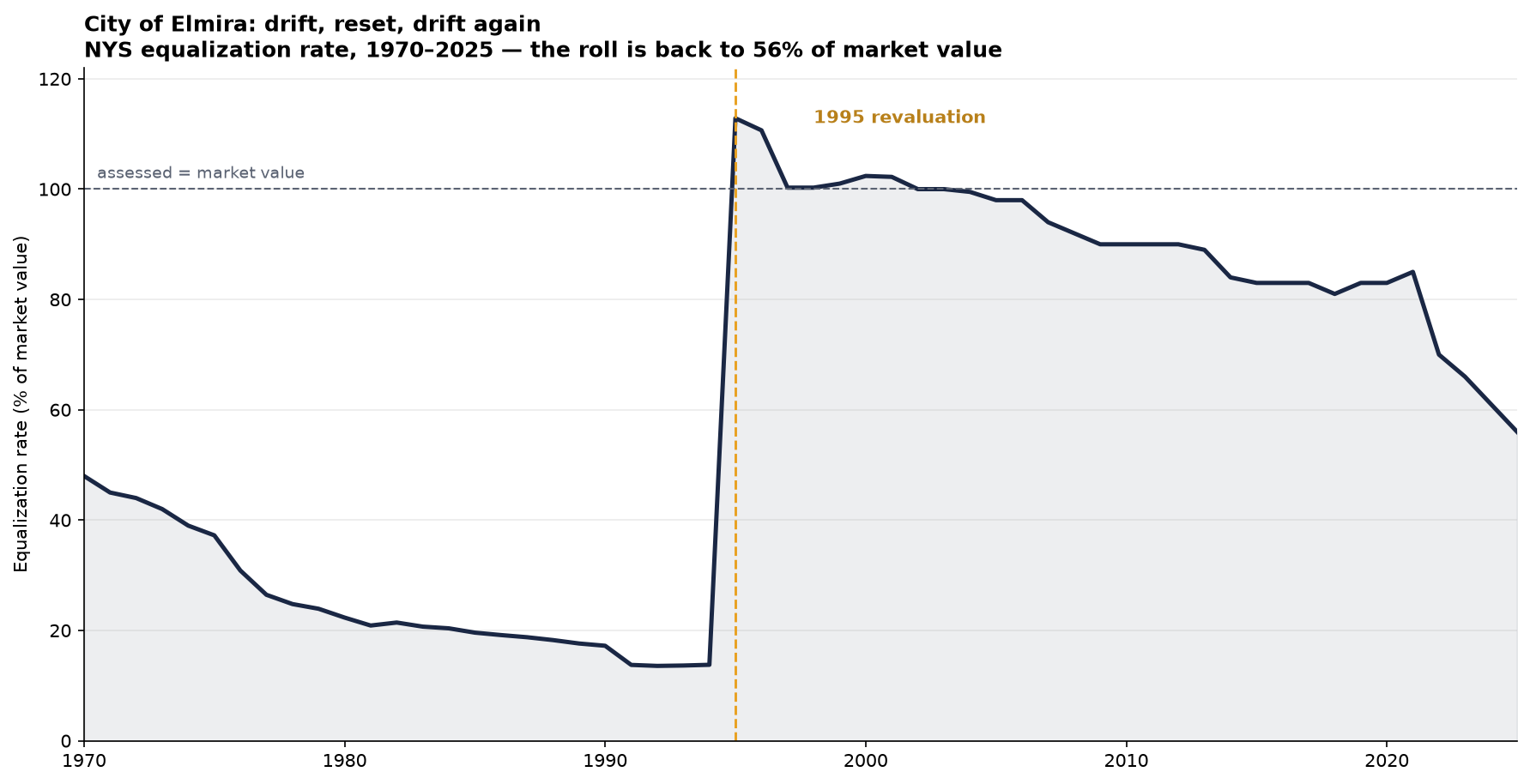
The state has measured Elmira's roll every year since the 1950s, and the record shows this
exact cycle running twice. The roll drifted from 48% of market value in 1970
to 13.8% by 1994. The 1995 revaluation reset it to 112.9%.
Since then it has slid back to 56%. Thirty-one years on, the city sits
roughly where it stood in the mid-1970s, on the way down to the last reassessment. That is
the point at which it last became unavoidable.
See the full series and method →
Every reassessment is preceded by exactly this shape.
NYS equalization rate, City of Elmira (SWIS 70400), 1970–2025.
Source: data.ny.gov e6pv-77bh.
Mass reassessment is legal, it is doable, and other New York cities do it
routinely. Elmira has not done one since 1995.
The reason is not technical and it is not financial. It is political. A reassessment
moves the tax burden around. The assessments that drifted farthest below market belong
disproportionately to long-time homeowners, and those owners vote in higher numbers.
Selling is no guarantee of an update either: only 1.9% of residential ownership
transfers from 2021 to 2025 saw any assessment change at all. A reassessment would raise
bills wherever a property is under-assessed today and lower them wherever it is
over-assessed, no matter when it last changed hands.
Reassessment has upfront costs. The city must hire contract
assessors, notify every property owner, and staff an appeals process for the
inevitable challenges. For a city with budget pressure, this looks like a
significant investment for a politically painful outcome.
The "reassessment doesn't raise revenue" framing obscures who it helps.
It's technically true that a mass reassessment doesn't change the total tax levy —
the city sets a rate against the new base to collect the same amount.
But it does raise taxes on specific households (those with stale, low assessments)
and lower them on others. The winners are largely invisible; the losers are loud.
Rate increases are politically easier in the short term.
Rate increases spread the pain across everyone proportionally. The city can point
to rising costs and a fixed rate of assessment growth. The cumulative inequity
is diffuse and hard to mobilize around.
Updates are rare and arbitrary, not triggered by sales. Only 1.9%
of residential ownership transfers from 2021 to 2025 got any assessment change. So
the roll does not split cleanly into "recent buyers, updated" and "long-time owners,
frozen." It is closer to a lottery. Whichever parcels happened to get touched,
whenever that was, for whatever reason.
The freeze quietly penalizes visible investment. A sale almost never
triggers a reassessment. A major renovation can. So the rare home reassessed upward
is often one the owner just put money into, while identical untouched houses stay
frozen at decades-old values. Your bill ends up depending on the vintage of your
assessment, and that discourages the upkeep a shrinking city needs.
What a Reassessment Actually Takes
The "it costs too much" objection has a concrete answer: New York State
subsidizes reassessments and provides direct technical assistance.
NYS ORPTS — the Office of Real Property Tax Services — runs a
Reassessment Assistance program specifically to help municipalities like Elmira.
The state reimburses a portion of reassessment costs and provides technical support,
including access to statewide sales data and appraisal methodology guidance.
The upfront expense, long used as a reason to delay, is partially covered by
the state that mandates the equalization system in the first place.
And the state has already priced it for Elmira specifically. ORPTS's 2009
review of assessment options for
Chemung County put a complete city reassessment at $341,000 gross —
$224,000 after state aid, at $35 a parcel across the 9,745 parcels it
counted (p. 28). Those are 2009 dollars, so treat them as a floor rather than a quote. For
scale, the city's General Fund runs about $47M a year. The same study notes the practical
hurdle is not the money: the city would need to amend its charter to adopt a
formal assessment cycle, and at the time had no plan to reassess at all.
The typical process for a NY municipal mass reassessment:
Decision and budget appropriation. The City Council approves
funding. This is the gating step — without a budget line, nothing moves.
Hire a mass appraisal contractor. The city issues an RFP and
selects a licensed appraisal firm. These firms have experience with NY municipal
rolls and know the ORPTS certification requirements.
Data collection and field work. Assessors visit and photograph
properties, update condition records, and gather sales data. For a city the size
of Elmira (~9,600 residential parcels), this takes several months.
Preliminary roll and owner notification. Every property owner
receives a notice of their proposed new assessed value, typically 30+ days before
the formal grievance period opens.
Grievance Day and Board of Assessment Review. Property owners
who disagree with their new value appear before the Board of Assessment Review.
A higher volume of challenges is expected in a reassessment year — this is normal
and built into the timeline.
Final roll and state certification. After appeals are resolved,
the final roll is filed and certified to NYS ORPTS, which updates the equalization
rate. The city sets a new tax rate on the larger base to collect the same levy.
A full mass reassessment in a city the size of Elmira typically takes
18 to 24 months from budget authorization to certified final roll.
NY law allows the city to phase in the resulting value changes over up to five years,
which limits the size of any single year's increase for households whose assessments
rise significantly.
Van Etten and Veteran — two small Chemung County towns — both completed mass reassessments
to 100% of market value in recent years. Their equalization rates now sit at 100% while
Elmira remains at 56%. The tools and precedent exist within the same county.
Who Has to Act
A mass reassessment does not happen on its own. Specific people in Elmira city
government have to decide to do it.
The Assessor cannot order a mass reassessment alone.
The city assessor is appointed by the mayor and keeps the roll running day to day.
That means updating individual parcels when they sell, handling grievances, and
certifying the annual roll to the state. Redoing all ~9,600 residential parcels is a
different thing. It costs money, so it has to be in the budget, and that takes the
Mayor and City Council.
The Mayor writes the annual budget and sets the priorities. No
reassessment has appeared in an Elmira budget in recent memory. Putting one there
takes a mayor willing to take the backlash from long-time homeowners whose bills
would go up.
The City Council approves the budget. It could add a reassessment
line, or tell the administration to apply for ORPTS help. Council members answer to
wards where frozen assessments mostly favor older, longer-settled residents. Those
residents vote.
NYS ORPTS can lean on a city through the equalization process,
because a rate that stays low is a public signal that the roll has decayed. It
cannot make a city reassess. The state writes the rules and helps pay the bill. It
cannot make the political decision.
Strip it down and the freeze is a choice by elected officials. They answer to homeowners
with stale assessments more than they answer to recent buyers. And more than they answer
to renters, who pay the inflated taxes indirectly, folded into their rent. That
imbalance does not fix itself. It takes organized pressure.
Grievance Day
Every year, Elmira property owners can formally challenge their assessed value. The ground
that fits Elmira is not the obvious one.
Almost no Elmira home is assessed above what it would sell for.
The roll sits at roughly 47% of market value. A home assessed at
$40,000 here typically sells for about $77,000. So the usual
grievance — an excessive assessment claim, arguing your assessment is higher than
your home's market value — will not succeed for most people in this city, and filing one
invites a closer look at your property.
New York gives you a second ground, and it is the one Elmira's roll actually
violates: unequal assessment. You do not have to show your assessment exceeds your
home's value. You have to show it is assessed at a higher fraction of its value
than property in the city generally. The state publishes the benchmark for you — the
Residential Assessment Ratio, 52.1% for Elmira
in 2025.
The test: divide your assessed value by what your home would realistically
sell for. If the answer is meaningfully above 52.1%, you are
carrying more than your share and have a real case. Our
sales analysis finds this concentrated among the city's
lower-valued homes — but the ratio is what matters, not the price, and the only way to know
yours is to work it out.
How to file
Confirm your assessed value at the Chemung County real property portal
(chemung.sdgnys.com) or on your tax bill.
Gather evidence. Recent sale prices for comparable homes on your street
are your strongest argument. Condition issues (structural problems, vacancy nearby,
deferred maintenance) also support a lower value.
File Form RP-524 with the City of Elmira Board of Assessment Review.
Forms are accepted after July 1 and on or before the third Tuesday in July each year.
Available from the City Assessor's Office at City Hall, 317 E. Church St.
Appear on Grievance Day — the third Tuesday of July, 4:00–8:00 PM.
Appointments are recommended. The hearing is informal; you present your evidence and
the Board decides.
If denied, appeal to SCAR. For owner-occupied one- and two-family
homes, the Small Claims Assessment Review is a simplified proceeding before a state
hearing officer. Nominal filing fee, no attorney required.